
How Play Can Reduce Challenging Behaviours and Build Resiliency in Youth
Submitted by Sarah Little and Nicholas Damjanoff, YMCA of Lethbridge
Play can be used to foster relationships and de-escalate behaviours in youth by providing stress management, awareness, and building confidence. Play can also increase self-awareness, social awareness, and skills used for regulation by providing emotional growth. Play can be used as a safe way for kids to explore and make mistakes through testing boundaries, exploring emotions, and practicing interactions with others. Play is seen to increase teamwork, bonding, and rapport amongst peers leading to an increase in confidence and for the de-escalation of challenging behaviours.
De-escalation is then defined as “reduction of the intensity of a conflict or a potentially violent situation”. During escalation, the amygdala is activated, causing either a flight, freeze, or fight response. In turn, the activation of the amygdala can override the prefrontal cortex, the part of the brain that manages decision-making and rational thinking. Play can then be used to help regulate the youth’s nervous system, which in turn can de-escalate behaviours. This is especially relevant as the youth’s brain, including the prefrontal cortex, are not fully developed until 25 years of age.
As the Community Access Liaisons (CALs) at the YMCA of Lethbridge, we have personally seen behaviours in youth that can be negative, which can lead to unfortunate repercussions, such as being suspended from the facility or rejection by their peers. By using play and engaging with youth, the CALs have been able to build rapport and mitigate challenging behaviours. In addition to spontaneous play throughout the Cor Van Raay YMCA facility, the CAL team hosts a weekly Youth Engagement Program with activities designed to create opportunities for play. For example, one week we created a scavenger hunt to engage the youth in play that puts their critical thinking skills and physical literacy to use. For the scavenger hunt, the youth were provided with clues and were asked to find the corresponding answers throughout the Cor Van Raay YMCA facility. The youth could do this by themselves or as a team. The CALs were there to guide the youth through the scavenger hunt as needed. The youth then ran from clue to clue to finish the scavenger hunt. Throughout the activity, the youth expressed joy, pride, and collaboration while completing the scavenger hunt. We saw signs of challenging behaviour reduced due to the activity providing regulation and structure.
By engaging in group activities and play, challenging behaviours can be mitigated. Youth create positive relationships with their peers, build rapport with safe adults in the community, and aren’t subject to suspension or social isolation as often. Through trial and error, youth work on impulse control and can engage in thoughtful and meaningful responses to challenging situations. This can help the youth as they grow, and allow them to become more considerate, cooperative, accepting, and flexible. This growth can assist youth in building stronger relationships and help them continue to grow and learn in stressful environments as they mature. Play creates shared experiences where relationships and future friendships can grow. These shared moments can also help with stress management, awareness, and building confidence.
So, How Does Play, Play a Role in Building Relationships?
Development of Social Skills
Bonding with peers
Self-expression and emotional regulation of behaviours
How Does Play De-escalate Behaviours?
Creating calmness and reduces anxiety and fear, creates resiliency.
Mindfulness
Conflict resolution/Improves Critical thinking skills.
Regulation of Emotions
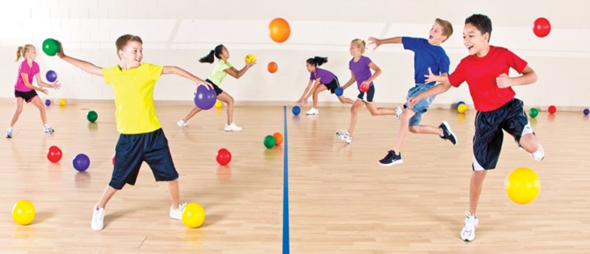
Kids playing dodgeball in a gym
Sources and References
https://www.psy-ed.com/wpblog/play-and-social-skills-development/
https://dougnoll.com/emotional-competency/de-escalation-children/
https://www.childrensinstitute.net/about-us/blog/power-play-developing-social-emotional-skills-and-addressing-challenging-behavior
https://www.cisa.gov/sites/default/files/2022-11/De-Escalation_Final 508 %2809.21.21%29.pdf